

The nine points that go missing
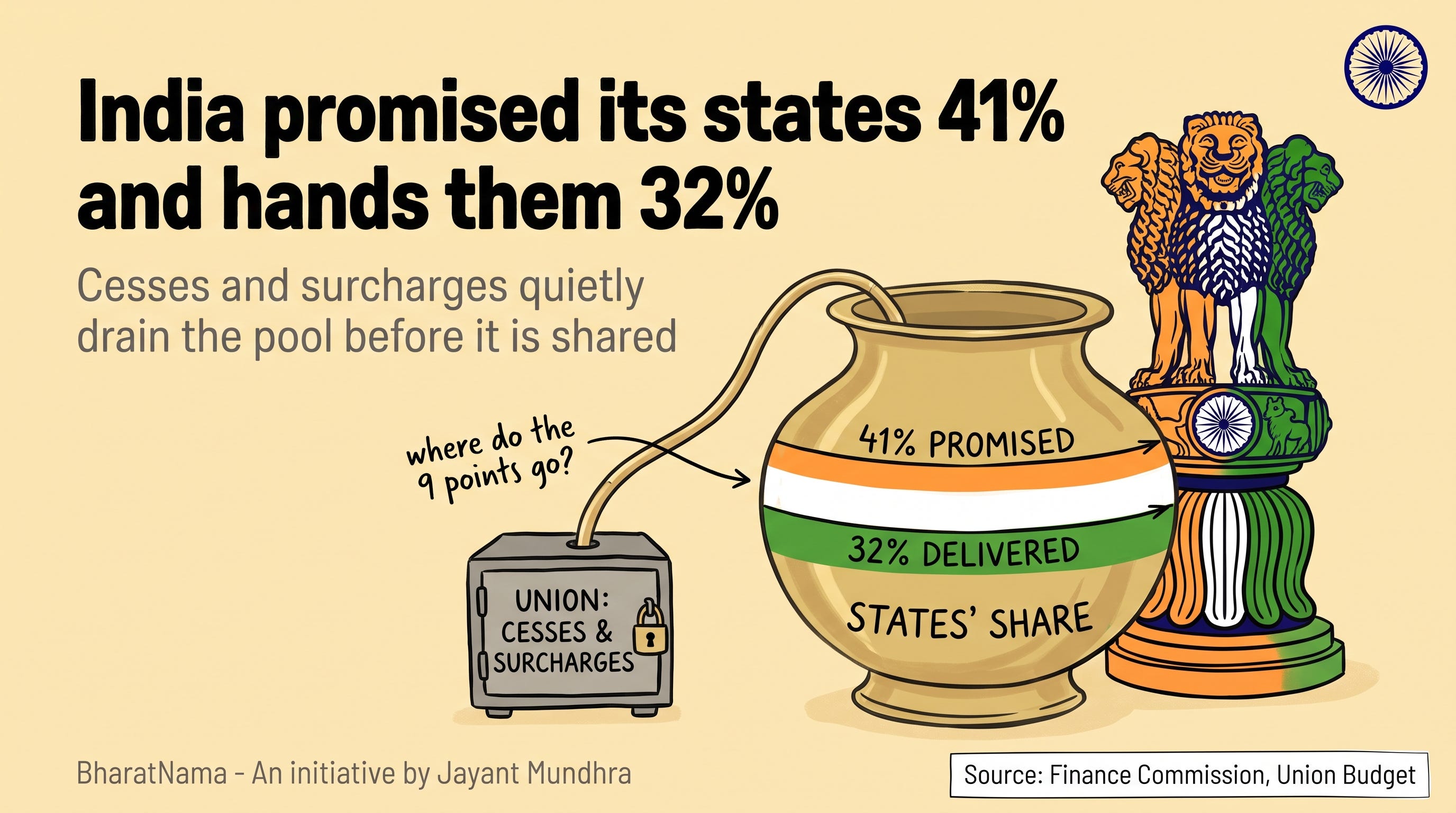
Here is a number that should bother anyone who cares about how India is run. The Finance Commission says India's states are entitled to 41% of the Centre's tax pool. The states actually get about 32%.10
That nine-point gap is not an accounting slip. It is the single most important fact about Indian fiscal federalism today, and almost nobody frames it this way.
The trick is elegant. The Constitution lets the Centre keep two kinds of tax entirely to itself. One is a cess, a tax levied for a stated purpose, say education or clean energy. The other is a surcharge, a tax on a tax. Neither is shared with the states.5
So the Centre has a lever. Raise money through ordinary income tax or GST, and 41 paise of every rupee flows to the states. Raise the same money through a cess instead, and the states get nothing.
Guess which one a revenue-hungry Centre reaches for. The headline devolution rate has never looked more generous. The effective one has rarely looked worse. That is the whole story.
How the pool actually works
Start with the plumbing, because the plumbing is the point.
India's Constitution hands the Centre the big, buoyant taxes: corporate tax, income tax, GST, customs. It hands the states the big spending jobs: hospitals, schools, police, roads, agriculture. That mismatch between who collects and who spends has a name, vertical fiscal imbalance, and every large federation lives with some of it.
To bridge it, the Constitution orders a Finance Commission every five years to decide what share of the Centre's taxes the states get. That shared portion is called the divisible pool.
The 14th Finance Commission raised the states' recommended share from 32% to a landmark 41-42%.1
The 15th kept it at 41%.1
The 16th, whose report covers 2026 to 2031 and was accepted in the 2026-27 Budget, kept it at 41% again, resisting demands from 18 states to push it to 50%.1 2
On paper, then, nearly half the Centre's taxes go to the states. In practice, far less does. The reason sits in one line of the Constitution.
The loophole was written in the year 2000
Before 2000, the sharing arrangement was narrower and messier. The 80th Amendment fixed that by pooling all central taxes together and giving states a single share of the lot.5
It was sold as a win for the states, and in one way it was. But tucked inside the same amendment was a carve-out. Cesses raised for a specific purpose, and surcharges under Article 271, were placed outside the divisible pool.5
The original logic was reasonable. A cess is money collected for a named job, so the argument went that it should not be handed to states as untied cash to spend on anything. The Fourth Finance Commission said as much back in 1965.
Here is where it gets strange. That logic only holds if the money actually reaches the job it was collected for. Increasingly, it does not.
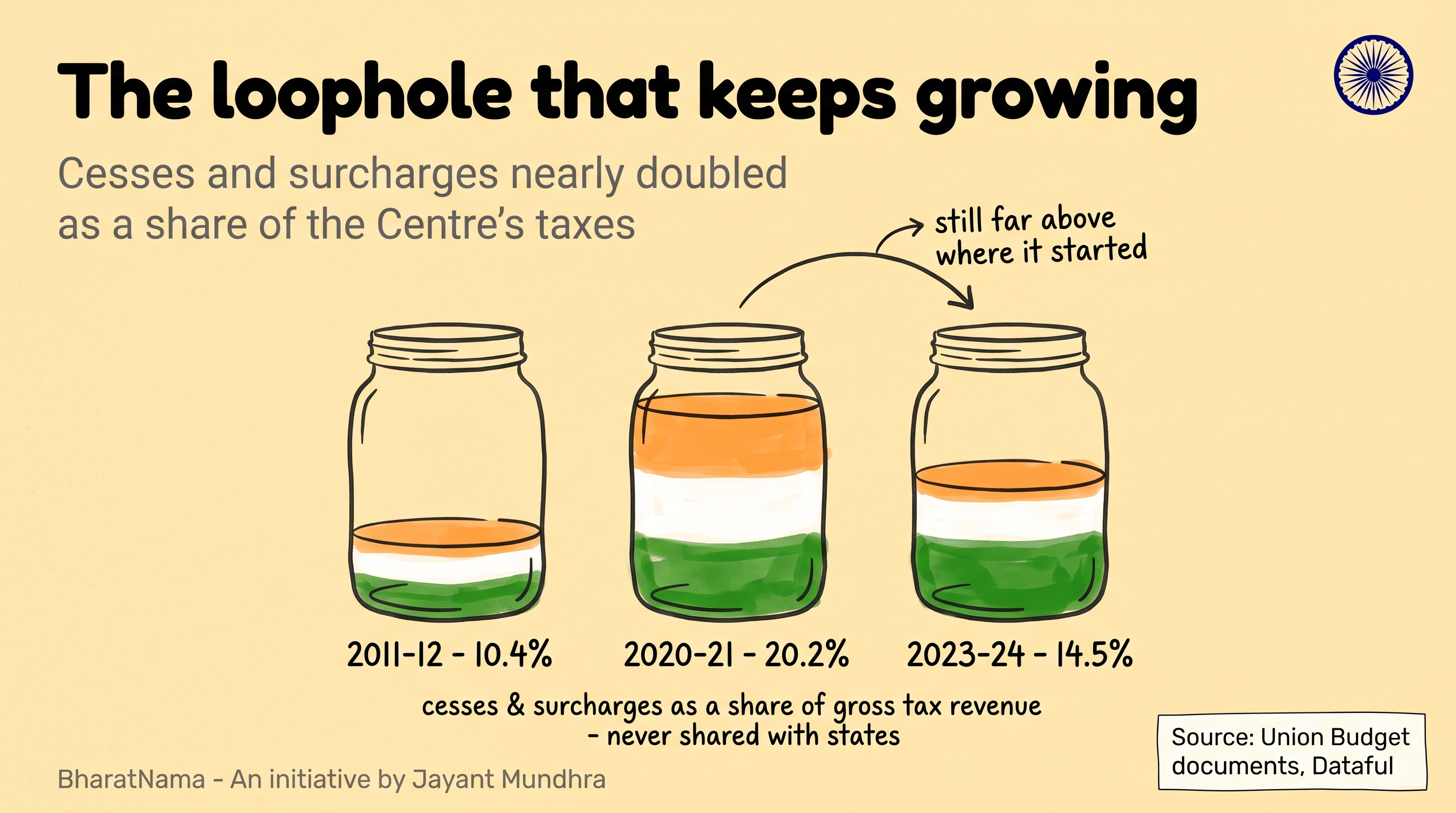
The share of cesses and surcharges in the Centre's gross tax revenue tells the story of a loophole growing into a pillar:
Around 10.4% in 2011-12.3
A peak of 20.2% in 2020-21, roughly double.3
Still 14.5% in 2023-24, well down from the peak but far above where it started.3
Every rupee inside that rising share is a rupee the 41% formula never touches. The pool shrinks before the split even happens.
The auditor's inconvenient numbers
The one defence of keeping cesses out of the pool is that they are ring-fenced for their stated purpose. India's own auditor has demolished that defence.
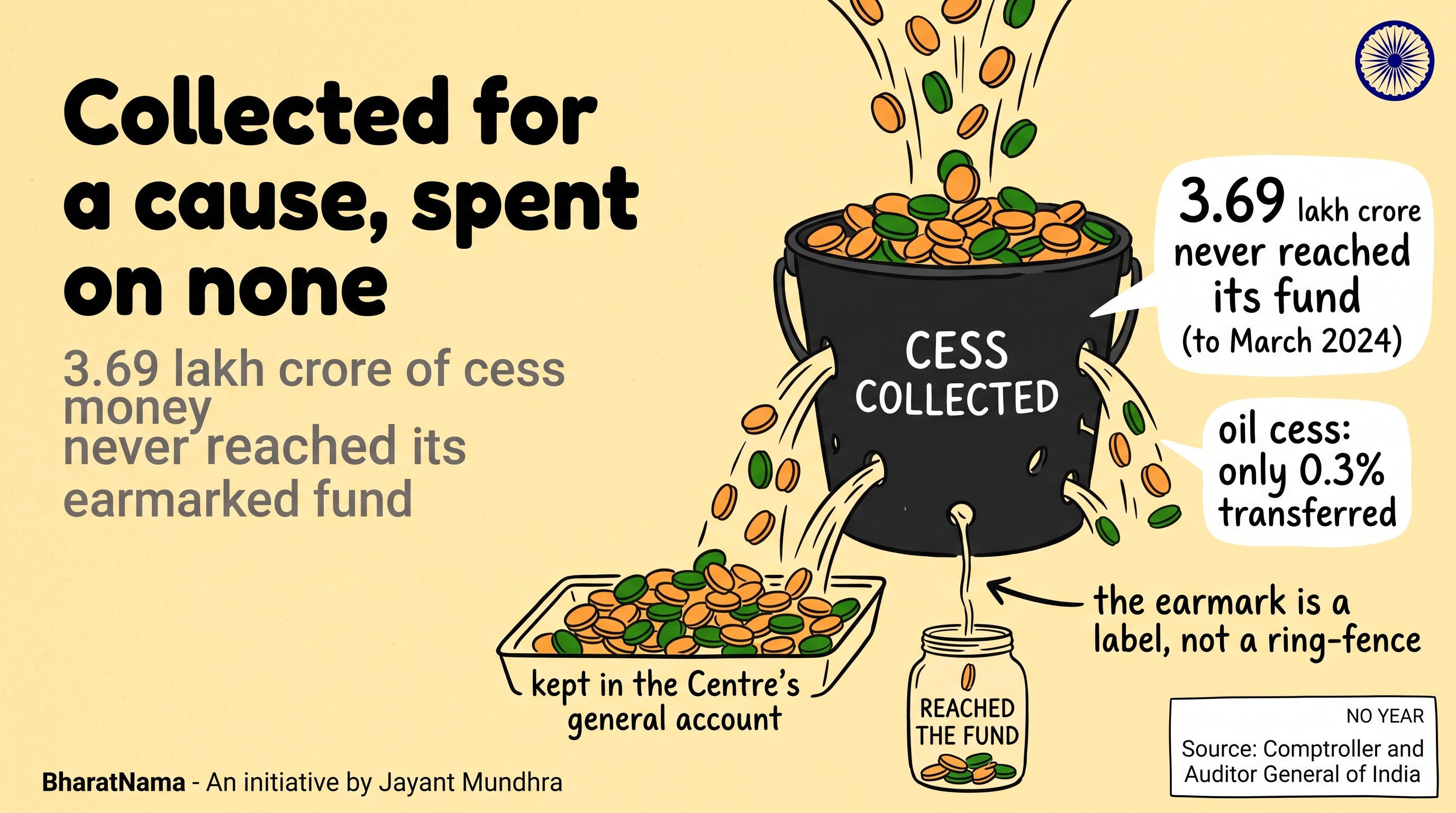
The Comptroller and Auditor General, in its Report No. 16 of 2025, found that ₹3.69 lakh crore of cess money had simply never been moved to the reserve funds it was earmarked for, as of March 2024.4 It was collected in the name of highways, health, education and the rest, and then left sitting in the Centre's general account.
The detail is worse than the headline:
The oil industry cess raised about ₹2.9 lakh crore since 1974-75. Just ₹902 crore, or 0.3%, reached the fund it was meant for.4
Health and education cesses worth ₹37,537 crore collected between 2018-19 and 2023-24 never reached their dedicated funds.4
This is not new. An earlier CAG audit found that in 2018-19 alone, 35 different cesses raised about ₹2.75 lakh crore, of which only ₹1.64 lakh crore went to the funds they were levied for.12
So the sequence is this. The Centre taxes citizens in the name of a specific cause. It keeps the states out of that money by calling it a cess. Then it often does not spend it on the cause either. The earmark is a label, not a ring-fence.
This is exactly the kind of thread I keep pulling on, and it is the sort of thing we go back and forth over in the BharatNama WhatsApp community, where I share a smaller India deep-dive like this with thousands of readers every morning (t.ly/h2jq1).
December 2025: the loophole gets a new lease
If you think this is a story about old habits, watch what just happened.
The GST compensation cess was a special levy, brought in when GST launched to make good the revenue states lost in the switch. Its proceeds flowed back to the states. It was always meant to be temporary, and its statutory life runs out on 31 March 2026.6
Instead of letting that revenue fold into ordinary, shareable GST, Parliament acted in December 2025. It passed the Central Excise (Amendment) Bill and moved the Health Security to National Security Cess Bill, both aimed at tobacco and pan masala.6
The excise duties rise to offset the ending compensation cess.6
A new production-based cess targets pan masala and gutkha machines.6
Demerit goods like tobacco sit at the 40% GST slab, but the top-up now comes through excise and a cess, not a shared tax.6
Read the manoeuvre plainly. A levy that used to flow to the states is expiring. It is being replaced by levies that stay entirely with the Centre, wrapped in the language of public health and national security. A state-friendly tax dies, and a Centre-only tax is born in its place.
Where India stands, against itself
Now break the national number open, because the pain is not shared evenly.
Cesses fall heaviest on consumption, and consumption is highest in India's richer, more industrialised states. So the states that generate the most tax are the ones that lose the most when revenue is routed through a cess rather than the pool. The loophole quietly punishes the states doing the economic heavy lifting.
The 16th Finance Commission tried to answer this on the distribution side, and this is where its real changes sit. It left the 41% share alone but rewired the formula that splits the pool between states:2
A new "contribution to GDP" criterion, weighted 10%, rewards high-output states for the first time.2
The old "tax and fiscal effort" weight was scrapped.2
Income distance, the equity measure, was trimmed from 45% to 42.5%; population nudged up to 17.5%; area cut from 15% to 10%.2 1
The result is a tilt towards the productive south and west:
Karnataka rises from 3.65% to 4.13%, the single biggest gainer.8
Maharashtra edges from 6.32% to 6.44%.8
All five southern states gain share under the new formula.8
But notice what this really is. Rewarding rich states with a bigger slice partly offsets the fact that those same states lose the most to cesses. It treats the symptom, the division of the pool, while leaving the disease, the shrinking of the pool, untouched.
And the 16th FC went further in a way that stings the weakest states. For the first time, it discontinued the Article 275 revenue deficit grants that used to plug the gap for states like Himachal Pradesh and Punjab, betting that state finances will run surpluses.9 It did expand local body grants sharply, to about ₹7.9 lakh crore.9 But that shifts money from untied constitutional entitlements towards conditional, Delhi-designed grants. That is centralisation dressed as cooperative federalism.
What India can learn from Australia
India is not alone in facing a wide gap between who taxes and who spends. Australia's federal government collects roughly 80% of public revenue and lets its states carry a huge share of the actual services. The imbalance is as steep as India's. The difference is entirely in the machinery.
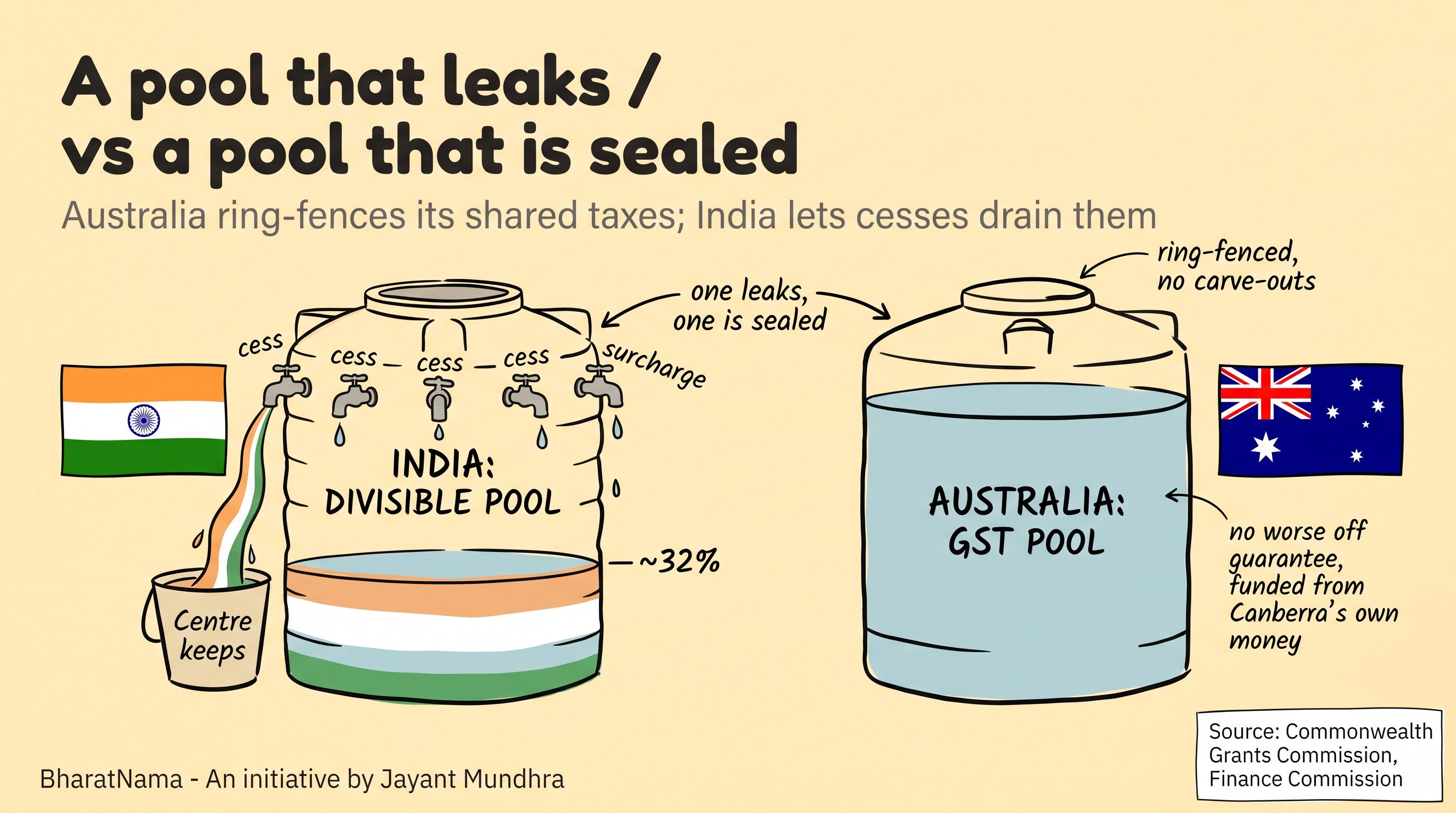
Australia's answer is a ring-fenced pool. The entire GST take is dedicated to the states and territories, and Canberra cannot invent a "national security cess" to siphon money out before the split. There is no loophole to grow.11
The sharing is run by the Commonwealth Grants Commission, an independent body that does something India's system does not. It measures each state's real capacity to raise revenue and its real cost of delivering services, then tops up the weaker states so every state can offer a comparable standard.11
Two features are worth India's attention:
A "no worse off" guarantee, legislated to 2026-27 and extended by agreement to 2029-30, protects every state during reform. Crucially, Canberra funds these top-ups from its own money, not by raiding the shared pool.11
A relativity floor, now 0.75, ensures no state's per-person GST share collapses below a set level.11
The lesson is not "copy Australia". India's scale, its federal politics and its fiscal room are all different. The transferable idea is narrower and sharper. A federation can run a huge vertical imbalance without wrecking trust, but only if the shared pool is broad, ring-fenced, and immune to unilateral carve-outs. India has the independent body in the Finance Commission. What it lacks is the sealed pool.
The state-versus-state spread and the Centre-versus-state tug are the kind of tension I unpack most days for the BharatNama community, and if this edition is your sort of thing, that is where the daily version of it lives (t.ly/h2jq1).
What to watch
Whether the 2026-27 Budget's numbers hold: fiscal deficit is targeted at 4.3% of GDP, down from 4.4%, and tax devolution to states is pegged at ₹15.3 lakh crore.7 A tight deficit target is exactly the pressure that pushes the Centre towards cesses.
The rollout of the Health Security to National Security Cess from April 2026, and how much tobacco and pan masala revenue it locks away from the pool.6
Whether the discontinued revenue deficit grants force hill and special-category states into fresh borrowing.9
Any move, however unlikely, to bring cesses and surcharges back inside the divisible pool. Without that, the 41% will keep meaning 32%.
The one line
India's states were promised 41% and handed 32%, and the missing nine points are not lost to arithmetic but to a loophole the Centre has every incentive to keep widening.
And well that is it for today's edition. That said, do check out my core WhatsApp community Biz News+ where I share 4-5 deepdives from the world of business, economics & public economics daily: https://t.ly/h2jq1
And if you want to understand where China stands and what it means for India, do check out my companion newsletter, Decoding the Dragon: https://t.ly/t7uhs
And, do check out my work on the following platforms as well: Instagram, LinkedIn and Youtube
Best,
Jayant
References
1. PRS Legislative Research, Report of the 16th Finance Commission for 2026-31: https://prsindia.org/policy/report-summaries/report-of-the-16th-finance-commission-for-2026-31
2. Business Standard, 16th Finance Commission retains 41% devolution, introduces GDP criterion: https://www.business-standard.com/budget/news/16th-finance-commission-retains-41-percent-devolution-gdp-criterion-126020101042_1.html
3. Factly / Dataful, Share of cesses and surcharges in gross tax revenue falls to 14.5% in 2023-24: https://factly.in/data-share-of-cesses-surcharges-in-gross-tax-revenue-falls-to-14-5-in-2023-24-down-from-the-high-of-20-2-in-2020-21/
4. Comptroller and Auditor General of India, Report No. 16 of 2025, Union Government: https://cag.gov.in/en/audit-report/details/128299
5. Drishti IAS, Cess and its role in Union finance (Articles 270-271, 80th Amendment): https://www.drishtiias.com/daily-updates/daily-news-analysis/cess-and-its-role-in-union-finance
6. Deccan Herald, What is the Health Security to National Security Cess Bill, 2025: https://www.deccanherald.com/india/explained-what-is-health-security-se-national-security-cess-bill-2025-introduced-in-lok-sabha-today-3815460
7. PRS Legislative Research, Union Budget 2026-27 Analysis: https://prsindia.org/files/budget/budget_parliament/2026/Union_Budget_Analysis-2026-27.pdf
8. ICRA, State Government Finances, February 2026 (16th FC inter-se shares): https://www.icra.in/Research/ViewResearchReport/6763
9. The India Forum, Continuity and Change in the 16th Finance Commission: https://www.theindiaforum.in/economy/continuity-and-change-16th-finance-commission
10. EnsureIAS, Centre-State Financial Devolution: https://www.ensureias.com/blog/current-affairs/centre-state-financial-devolution
11. Commonwealth Grants Commission, 2018 GST distribution legislation and no-worse-off guarantee: https://www.cgc.gov.au/about-gst-distribution/2018-gst-distribution-legislation
12. Shankar IAS Parliament, CAG report on cess collections (2018-19): https://www.shankariasparliament.com/current-affairs/cag-report
Can this one of the reasons why states which are mineral rich doesn't dilute their tax/royalties for mining as it is a major source of revenue for them? Such taxes/royalties at times become too unfeasible for companies to explore mining in new areas, which in turn affects the whole ecosystem.
Australia doing well, wondering how other countries handle this